Showing posts with label Filipino food. Show all posts

Saturday, August 10, 2013

A Binondo Food Pre-Walk: A Gastronomic Introduction

Fresh from an inspiring talk on the cultural legacies of Manila, me and my friends decided to take a sampler treat of the Binondo Food Walk made famous by Mr. Ivan Dy of Old Manila Walks. I called it a pre-walk since number 1: it was decided on impulse but we also wanted to take that Old Manila Walk tours someday; number 2: we got hungry and we called our Chinese travel buddy to give us some leads; and number 3: we're here in Manila anyway so why not?

Binondo was established in 1584 by Spanish Governor Lius Perez Dasmarinas. It’s the Chinatown of Manila and once was the center of commerce prior to World War II.  With Manila levelled during the war, commercial establishments has since moved elsewhere; but other than the hardy Chinese still working and living there in Binondo, one thing remained strong, famous and reminiscent of its old glory: the quintessential Chinese food. The dishes, samplers, treats and delicacies that wafts deliciously in the air reminds you that it’s a quarter past 3 and it’s meryenda time!

Our first stop: Dong Bei Dumpling at Yuchengco corner Tytana Sts. just behind the old Binondo church. This very small eatery had been described as a small, unassuming hole-in-the-wall restaurant. #Dongbei #dumplings

Small yet the place offers many mouth-watering treats. We ordered the pork dumplings as recommended by our friend. #dongbei #dumplings

The dumplings here are prepared in the resto where you can see them. Its also a good thing because you can be assured that everything you order are prepared fresh. #dongbei #dumplings

I wonder what this will become, is it the pork dumplings? the xiao pao? #dongbei #dumplings
The roll of dough was flattened meticulously to get that thin dumpling wrapper consistency, then filled with pork, shrimps, etc, fried or steamed....the list goes on...#dongbei #dumplings

The fresh dumplings looked good enough to eat already....don't worry, hungry as I was, I waited for the steamed version. An order consisted of 14 dumplings.  #dongbei #dumplings
Steamed pork dumplings with chives....this was what we ordered. Well, I'm not really a dumpling person, I don't like the taste of extenders I do not know. But this? This...was beyond words. Not a foodie, so all I could pathetically come up with is DELICIOUS in many tones, enunciations, intonations, modulations, pitches and cadences! Sigh, I became a fan! I will be back! And this was just the start of our pre-walk... #dongbei #dumpling

Our next stop was Wai Ying Fastfood at Benavides St. Our friend recommended its tai pao or the mean, large siopao! #waiying #taipao
It started looking like a very Chinese dinner as I watched through the window. That duck and other sweet meats displayed there paired with the hot, piping mami noodles on the side made me want to order my favorite yang chow fried rice for a really, stuffy-yummy five-course Chinese feast! But hey, our objective here was the tai pao, so I reined in my horses.... #waiying #siopao

It started with a hot glass of clear tea....it washed our palates from the tasty aftertaste of Dong Bei, prepared our tongue for another gastronomic surprise #waiying #siopao
This is not a siopao, this is a tai pao. The difference, as far as I saw it, was the size. But like an energy bar, its power-packed with different fillings, from asado, salted egg, steamed pork and who knew what else. 'Twas not as big as a plate, just a little bigger than the jumbo-sized siopao. It tasted great, better than what I can buy from the foodcarts. Its very filling, very tasty but really more than enough for me. If you go here, better come hungry. #waiying #taipao
They sliced it already so it can be shared. The steaming tai pao is already dinner for two. #waiying #siopao

We also ordered siomai and hakaw but what I kept coming back to was the tai pao. I already had one of these so I was not really surprised. It was delicious. period. Loved it? yes. Will be back? of course! #waiying #siopao

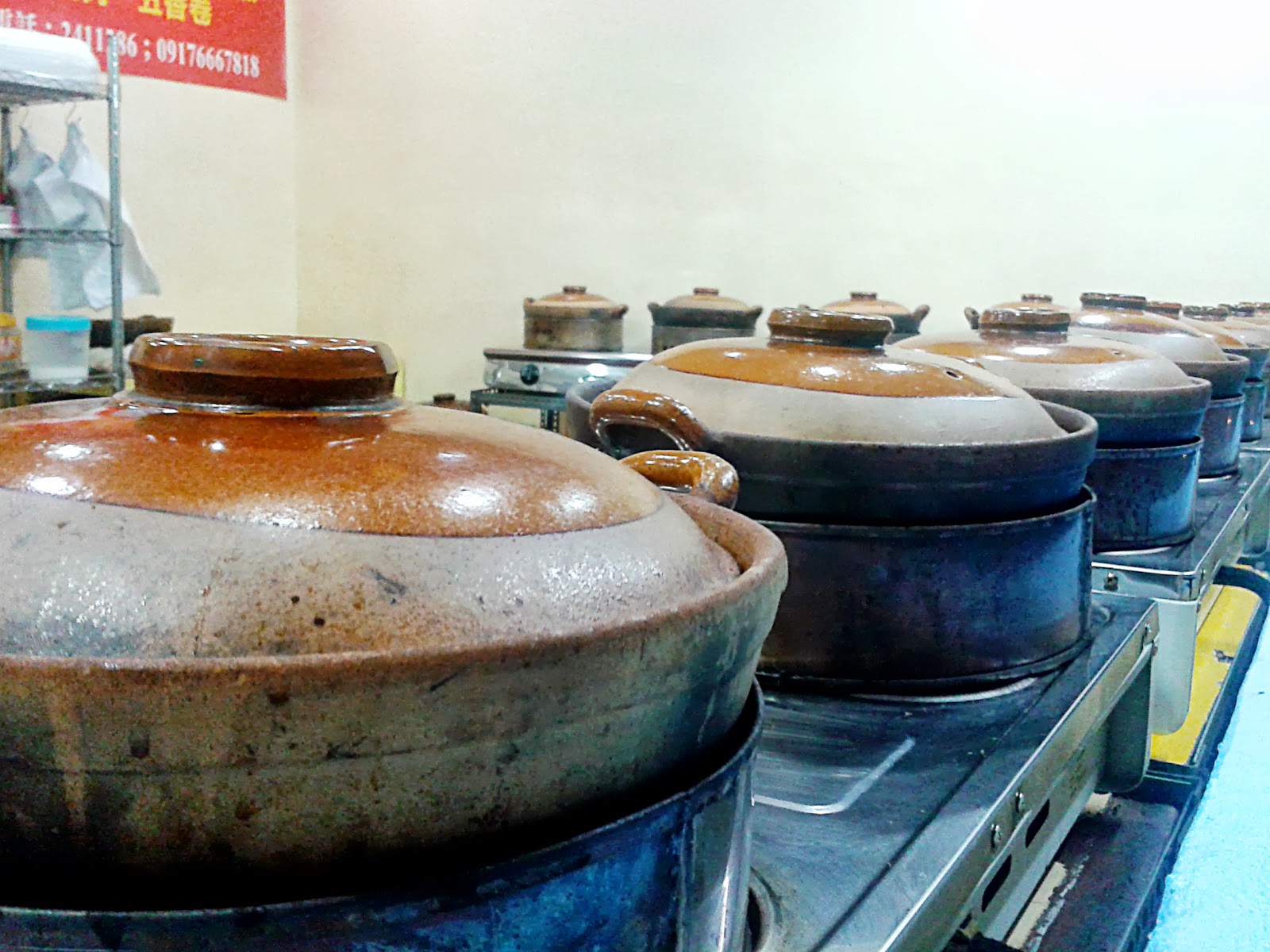
We passed by this carinderia-like store on our way back to Ongpin St.. No we didn't eat here but I was amused at the mini-cauldron pots containing the food - terracotta style. Now that's uncommon these days. #ongpin
Our travel buddy's list contained these words: freshly squeezed sugarcane juice. Wow! that was good advertising. We really looked forward to that freshly-squeezed sugarcane juice (so much that all we had so far was the hot tea from Wai Ying, not even water because we looked forward to that juice!).  #sugarcane

The Juice....was nowhere! ha! maybe we were lost or they went home already. So we just contented ourselves with the freshly-peeled-sugarcane-cane that can be bought from carts along Ongpin St.. Well, to spare my delicate teeth I gladly donated my share with a smile and a thought "Happy chomping!" #sugarcane
Next stop: Fried siopao along Ongpin St. It was just a store not a restaurant with a lot of food goodies other than the fried siopao. #friedsiopao

The fried siopao were already packed by singles, sixes or dozens. It was a regular sized siopao with a slight sear in its underside, proof that its fried, not steamed. #friedsiopao
I wanted to taste this, Machang, a glutinous rice preparation with meat filling at the center and wrapped in banana leaves dimsum style. But, I was getting really full that time and we still had one more stop to go. Well, much as I would like to nibble on my small fried siopao, I just took it home as pasalubong to my loved one with a line prepared that went "Dahling, I intentionally bought this for you! smack!" #friedsiopao
Last stop for the night: MaƱosa Restaurant along Ongpin St. A bit farther from the church, though good for burning all the food we ate earlier. Earlier on, those were appetizers and snacks. This place was for dinner. Our friend recommended its Maki and Makimi for a savoury finish. #manosa #makimi

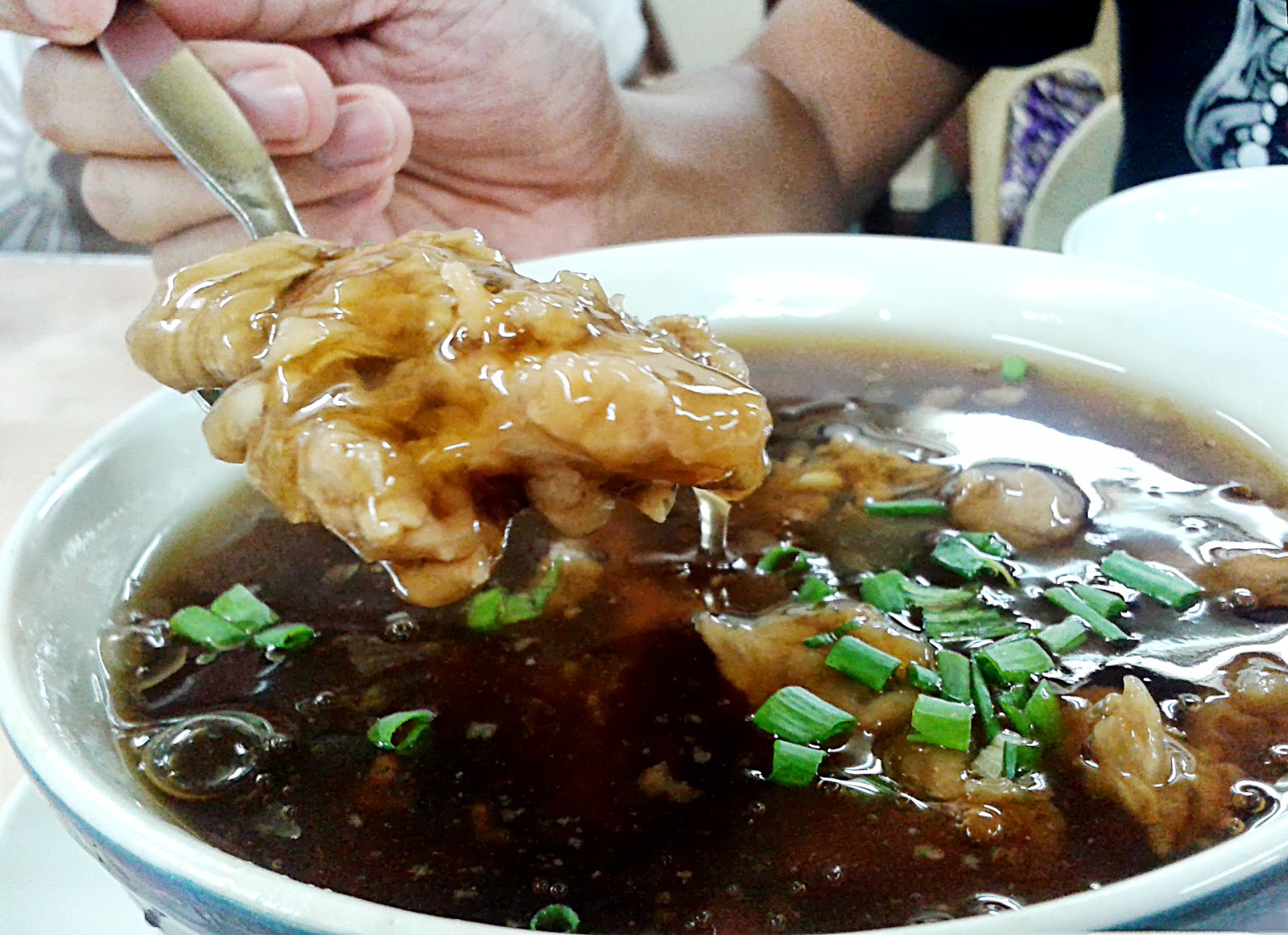
Maki, a thick heavily flavored soup poured over breaded pork chunks with leaks to top it off. It has a full flavor, heavy in the gut too. Warning: need more gut space for these, would also need rice. #maki
Makimi was another dish we ordered, same with Maki on the soup and pork chunks but served with noodles. #makimi

It was already late when we gave up, too full to have another look on the list. Thankfully realizing that the Maki was the last recommended stop. Oh well, what a tasteful introduction to the Binondo Food Trip. We have craved to do this for the longest time. Finally, we had our round.
I guess every foodie and blogger in town already had this experience in their archives, I am still thankful that I got to do mine. Well, this was a pre-walk. Next time I wanted to do the real walk, know more about the places we went to, their history, their success stories and other food stops we never knew. Next time I hope to join the tours of Old Manila Walks with my friends to learn more, to experience more, to discover more, to eat more, to gain weight.....nah! let's stick to the discovering and experiencing.....

Well, I hope you enjoyed this post. Till next time. chow!
 

Tuesday, April 12, 2011

Just Passing by in Albay

Travelling in Bicol by land gives one a sentimental journey through quaint straw houses, rolling hills and blue skies. It’s a welcome contrast from my home city where tall buildings are the only treats you have from the harsh sun.
I’ve always loved taking this dreamy ride down the road from Sorsogon to Legazpi.  Just a perfectly sleepy afternoon, yet contentedly sucking in the flavourful panorama of Bicolandia from our van window. Funny how life seems so slow in this region where the pounding of strong typhoons and monsoons is very much part of everyday life. Makes one think and admire the resilience of the Bikolanos as they steadfastly defy Mother Nature’s mood swings. Ah! Bicol…a land of contradictions.

After an exhilarating adventure in Donsol, my friends and I packed our bags, took the van going to Legazpi and prepared ourselves to another bout of the long bus ride home. But wait! Who would want to leave Bicol without a glimpse of the perfect Mayon? So we took a short detour and head out to the Cagsawa Ruins….

My batteries conked out by this time so I have to ask my friend, Mel Dimapilis, to lend me her pictures for this post. Thanks Mel!

Mayon Volcano is an active volcano that forms part of the Ring of Fire in the Pacific Rim. Mayon is famous for its ‘perfect cone’, almost symmetrical and smooth. If not for the 49 eruptions in its 400 years recorded history (wiki), the cone today would have been as perfect as it was centuries ago. It still was beautiful, well, if it showed itself. The clouds were relentless when we got there. Gee, methinks it wanted us to go back…

Folklore has it that the name Mayon is adopted from the legendary heroine Daragang Magayon (Bikol for ‘Beautiful Lady’).  The locals would add that if Mayon did not show itself to you, then it only means she wants you to come back. I already said yes but guess she was not convinced…oh well, we still loved her just the same.

Though the best view of Mayon is from Lignon’s Hill, still in Albay, the most famous view area is the Cagsawa ruins. The most destructive eruption of this still active volcano was in 1814 when it buried the town of Cagsawa.  The bell tower is the only remnant of the church buried by the volcanoe’s lava. Looking at the history of this temperamental volcano, it can be said that it is the most active in the country, erupting several times…and devastating when it did.

The Cagsawa Ruins is not only a place of historial value, but it also became a one-stop-shop for shoppers looking for anything Bikol - from food, handicrafts, shirts, even lava rocks if you please - thus, a haven for souvenir-hunters like me!

Bicol is known for pili, abaca and chili. The culture and development of the Bicol region were pretty much influenced by those three.

The pili tree bears fruit which is green to violet and contains the seed whre the famous pili nut can be found. The shell itself is so hard that cracking the pili nut is a talent among the bikolanos. 

The pili nut, Canarium ovatum, is found mostly in Bicol and is native to the Philippines. The nut is considered a cross between a macadamia and almond and is used in confectioneries such as candies, chocolates, ice cream and baked products. In Bicol, pili products can be seen all throughout the region and in different forms: sugar-coated, in small breads and the famous marzipan de pili. Marzipan in other parts of the world is a bar or paste made of sugar and ground almonds. Mazapan (as what the locals call it) or Marzipan de pili is an adaptation where almonds are replaced by grounded pili nuts. Yum! Uh-oh I accidentally ate mine while walking, so no pictures were taken by Mel.

The pili tree is a tall, oak-like tree, averaging 20 meters tall, resinous and resistant to strong winds and harsh weather; which is why they thrive effortlessly in bicol. There are three pili cultivars grown in the Philippines: katutubo, mayon and oas (Agribusinessweek, 2009).  Aside from a large tract of land planted to pili trees in Negros, there is still considered no commercial planting of the tree as a crop. Fruits are collected from gigantic trees (some are even centuries old they say) in the mountains near the provinces of Sorsogon, Albay, and Camarines Sur. Harvest season is from May to October, peaking in June to August.

Though other Asian countries are also planting pili, they are mostly grown as ornamentals. It’s only in the Philippines that pili nuts are produced and processed commercially. In 1977, the country exported around 3.8 tons of pili products to Guam and Australia. In the pre-war era, pili nuts were already being exported to Hawaii, Germany, France, Britain, and Japan, according to the Plant Industry Digest published in 1970.  To date, the only large buyers left are Hong Kong and Taiwan, where the nuts are used in the Chinese festive dessert known as the “moon cake” (Agribusinessweek, 2009).

I was still trailing Mel around the souvenir stores of Cagsawa, expecting to see just pili products and abaca handicrafts, when we chanced upon this stall selling big knives called "itak" and even swords. Apparently, these metalworks ae considered an industry in Tabaco, Albay...a town next to Legazpi. My naughty uncles once told me that the bikolanos used the steel from the railtracks to make these knives. Ha! well of course those stories were not true. The small metalworks industry is supported by the Department of Trade in Albay to improve the locals' skill and, thus improve their productivity.

I found these beautiful shell curtains when I lost Mel, so I used my phone cam...not bad for a celphone! a lot of stores also sell shell products.  I think these products were made in Ragay, Camarines Sur. I'm not sure so I'll do some research in the future.

I found Mel again taking pictures of another important product of Bicol: abaca. The bicol region ws once the flourishing capital of abaca long before the Americans came. Abaca, or Musa textilis, is indigenous to the Philippines, our very own. That's why the ropes that were used in hispanic galleon ships were called Manila Hemp, and the name stuck until today. The strong fibers of abaca made it an important crop especially in Bicol. Unfortunately, the abaca trees in bicol were struck by a disease long ago that prompted the government to plant abaca in other parts of the Philippines in order to save the industry. What I learned recently is that the Americans even brought (stole?) abaca to Ecuador.  Now Ecuador is the second largest abaca producer in the world, and a competitior of the Philippines. Its really a sad story but I'll dwell on it in my future post (I'm doing a photo-shoot of fibers and fiber production in the country and will post it once its completed).

Now back to Bicol handicrafts. Since abaca is still a dominant industry in the region, though not propagated as a crop same as the pili tree, people here have mastered the skill in producing fiber and weaving it into various handicrafts. The tedious process of scraping the fiber out of the leaves, drying, spinning it into threads, and weaving it into mats, baskets and bags takes more than two weeks where labor is very much intensive.  From the leaves to the baskets, these products are not easy to make.  For a cheap price of P10-30 for mats, well I should say that its too small for the effort these people put into it.

There are a variety of products that one can buy made of abaca and other local materials. I took this picture of a stall while Mel is busy on the other side. There were mats, hats, baskets and bags of different types.  The weavers and handicraft producers here have evolved from doing only plain abaca baskets and bags. Now, modern graphic designs can be seen in their products.

These bags are being promoted by Legazpi as the new eco-bags. Its made of abaca twines and can be used as shopping bags in replacement for the plastic ones. Legaspi is very much known for its abaca bags, from these eco-bags to the more sophisticated cocktail purses.

These mats are the new attractions. They called it flower mats and can be used as displays or as table runners.

These are abaca balls, popular during christmas season but can also be an all-year round decoration. They are made of abaca twines weaved into a ball.  This is a product of Pilar, Sorsogon.

These are among the popular hats around. Its a combination of abaca and the "banig" or barn leaves. Its pretty modern and can match your color anytime.
The third most important product where Bikol is known for is the "siling labuyo".  Well, these aint the real stuff but the people here honored the lowly siling labuyo by turning them into the ultimate bikol souvenir! Bikol is known for its typical hot dishes, laced with super hot chilis of this type and boiled in coconut milk until its dry and oily. Coconut produces oil that is healthy, consisting of short to medium chain fatty acids that are readily burned into energy and not deposited in the veins as fats (This is why coconut oil is different from other vegetable oils and much healthier) Wait, I'll go back to chilis. It is only in the bicol region where hot dishes are an everyday fare, sumptuous dishes that can rival the Thai, Indian and Mexican for the most spicy foods contest! When in bicol, give the bicol express a try...or even the chili ice cream! Ha! I tried it and I survived! felt like a medal of honor.

The Cagsawa Ruins is indeed a worthy stop in our journey. But, who would go home without a picture of the beautiful Mayon?  That completed our journey to Bicol this summer. Well, I promised to be back because Bikol still has so much to offer. Secret is, I'm from here and I'm one proud Bikolana!

Well, so long Mayon, see you around, take care and remain defiant against the typhoons and monsoons...and as my friend puts it, best wishes from one goddess to another!

Wednesday, March 30, 2011

Davao Cacao: Your Next Bite of M&M's Chocolates Might Just Come from Davao

Chocolate has long been known as the anecdotal “Drink of the Gods”. Long, long before the Spaniards ventured out to sea, the Aztecs of South America have already enjoyed this drink regarded as sacred that only the chieftains could afford it. Christopher Columbus discovered it from the Aztecs in the 15th century and brought it back to the new world, and that was the start of the world’s love affair with chocolate.

Until the 16th century, the bitter dark aromatic drink remains undiscovered beyond the Aztecs and Mayan civilizations until it was brought by Columbus to show Ferdinand and Isabella of Spain. Though it became a court favorite, it was the Spanish friars who introduced the wonders of the chocolate beans to the rest of Europe. It was served as beverage, but the Europeans added sugar and milk to neutralize the cocoa's natural bitterness and removed the chili pepper, replacing it with vanilla, another indigenous Mexican spice (wikipedia).

For hundreds of years, the chocolate making process remained unchanged. In the 18th century, mechanical mills were created that squeezed out cocoa butter, which helped create hard, durable chocolate. However, it was not until the arrival of the Industrial Revolution that these mills were put to bigger use. This was when people around the world began experiencing and consuming chocolates.


Now, how did the big names in chocolates – Hersheys, Van houten, Cadbury, Nestle, Lindt and eventually Mars – came to be? Well, at the end of the 18th century, the first form of solid chocolate was invented in Turin by Doret. This chocolate was sold in large quantities from 1826 by Pierre Paul Caffarel. In 1819, F. L. Cailler opened the first Swiss chocolate factory. In 1828, Dutchman Coenraad Johannes van Houten patented a method for extracting the fat from cocoa beans and making powdered cocoa and cocoa butter. Van Houten also developed the "so-called" Dutch process of treating chocolate with alkali to remove the bitter taste. This made it possible to form the modern chocolate bar. It is believed that the Englishman Joseph Fry made the first chocolate for eating in 1847, followed in 1849 by the Cadbury brothers. Daniel Peter, a Swiss candle maker, joined his father-in-law's chocolate business. In 1867, he began experimenting with milk as an ingredient. He brought his new product, milk chocolate, to market in 1875. He was assisted in removing the water content from the milk to prevent mildewing by a neighbour, a baby food manufacturer named Henri NestlĆ©. Rodolphe Lindt invented the process called conching, which involves heating and grinding the chocolate solids very finely to ensure that the liquid is evenly blended. This enabled Milton Hershey to make chocolate even more popular by mass producing affordable chocolate bars.  Hmmm....thanks to wiki for this info.

The Mars Company came later in the United States in 1911. The Mars Candy Factory was started by Frank C. Mars. He was taught by his mother how to make hand-dipped candies. Forrest Mars, son of Frank Mars and his first wife named Ethel, was inspired by a popular type of milkshake in 1923 and introduced the Milky Way bar, advertised as a "chocolate Malted Milk in a candy bar". This became the best-selling candy bar. It was incorporated as Mars, Inc. in 1920 and the company grew to be one of the biggest consolidated confectionary companies in the world.


The company produces world favorites such as M&M's, Snickers, and the Mars bar. Its other confections include 3 Musketeers, Dove, Milky Way, Skittles, Twix, and Starburst candy; Combos and Kudos snacks; Uncle Ben's rice; and pet food under the names Pedigree, Sheba, and Whiskas. It also owns the world's largest chewing gum maker, the Wm. Wrigley Jr. Company. The Mars family (including siblings and retired company CEO Forrest Mars Jr., Chairman John Franklyn Mars, and VP Jacqueline Badger Mars) owns a highly secretive firm, making the family one of the richest in the US.


Now what does Mars and chocolates have to do with us? Well, let’s go back again in history. With the spread of the popularity of the chocolate royal drink, the French established cacao plantations in the Caribbean, and Spain developed theirs in their Philippine Colony (Bloom 1998, Coe 1996).  The cacao plant was brought by a Spanish mariner named Pedro Bravo de Lagunas sometime in 1670.  The first plantings were done in San Jose, Batangas.  The country was the first in Asia to plant cacao and prepare chocolate drinks from cocoa beans.  Commercial cacao farms were established by a group of Filipino investors.  More cacao commercial farms were put up in Mindanao (Food and Agri-Business Monitor, 2010).  Cacao plantations continued to exist in the country, though smaller now than in the Spanish times. A cup of hot, bubbling, smooth chocolate starts with the lowly tablea.  Right up to the 70’s, and sporadically during the modern times, the processing of tablea were all done by hand.  Grinding the dark brown beans and shaped into discs which leave it characteristically coarse but full of aroma.  With problems hampering agriculture especially the cacao plantations during the Agrarian era in the 90’s, the local cacao industry did not flourish and tablea making was one of the first casualties of industrialization perhaps not only in the Philippines but probably the same with the rest of the world.

Now, somebody literally came to the rescue.  Mars, Inc. tapped Davao Region farmers for the supply of up to 100,000 metric tons of cacao for the next five years.  Mars has been doing business directly with farmers in different continents and came to Davao with a business proposition.  Since no single cacao plantation has the capacity to supply cacao of the magnitude required by Mars, Inc., Ms. Charita Puentespina has been asked to consolidate the cacao harvests of the farmers within Davao City (Balita, 2010).


Ms. Puentespina’s name has been synonymous with cutflowers ever since she mass-produced the orchid waling-waling (scientific name: Vanda sanderiana) in 1985 through embryo culture. When she passed on the management of her orchid business to her children, she started her own love affair with cacao. Since then, Puentespina became the biggest consolidator of all wet beans produced by farmers within a 25-kilometer radius from the Puentespina farm in Malagos, where a total of 17 hectares of the Puentespina Farm is planted to cacao. The Farm established fermentation and drying facilities to produce good quality beans.  Cacao is also sourced from satellite cacao farms in Davao Oriental, Compostela Valley and Sto. Tomas in Davao del Norte (Balita, 2010). She established the Mars Cocoa Development Center to serve as a hub for cacao farmers in Davao City.

The scientific name of the cacao tree, where chocolate is made from is Theobroma cacao. Theobroma means "food of the gods". The word cacao was derived from the Aztec word cacahuatl, learned at the time when it was first encountered by the Spanish in South America, but later on adopted into the spanish language. The word cacao entered scientific nomenclature in 1753 after the Swedish naturalist Linnaeus published his taxonomic binomial system and coined the genus and species Theobroma cacao (wikipilipinas)


Cacao grows on relatively higher ground, to an elevation of 1,000 meters above sea level usually in between other trees where it is shaded for optimal growth. It thrives best in areas where there is an evenly distributed rainfall throughout the year. Upon reaching maturity, the cacao pods sprout from its trunk and branches. Embedded inside the pods are layers of 20-60 cacao beans (Food and Agri-Business Monitor, 2010).

Davao remained the highest producing province in the country. In Davao, the major cacao-producing provinces were Davao del Sur (1,669 tons), Davao City (832 tons), Davao Oriental (481 tons), Bukidnon (455 tons), and Davao del Norte (319 tons) (Food and Agri-Business Monitor, 2010).

However, comparing our progress among our neighbors in the Asian region, the Philippines have the smallest production of cacao beans at 5,000 metric tons of cacao beans in 2010. Its highest production was in 1980 with 20,000 tons and 1990 with 35,000 tons, declining over the years as farmers abandoned cacao farming for more profitable crops (Sun Star Davao, 2011). Embedded inside the pods are layers of 20-60 cacao beans. 

The Mars Cacao Development Center in Malagos aims to change the fate of Davao cacao farmers. The Center has hosted no less than 4,000 farmers who have received free training on the proper growing, rehabilitation and post-harvest of cacao trees. Once the cacao farms are rehabilitated, they will yield a very good harvest.  Mars, Inc. needs 100 metric tons of cacao beans in the next five years valued at 300 million dollars.  This is good news for farmers since Mars, Inc. has increased the price of cocoa to P110 per kilo. According to a news article, Mars buys the dried cocoa beans from the Davao farmers without exclusivity. The farmers sell via international commodity trading (Balita, 2010).


Inside the Center, fermentation and drying facilities were established to further control quality of the wet beans produced by the farmers.  It is in the fermentation that the flavor and aroma profile of the chocolate is developed, not only in the variety.

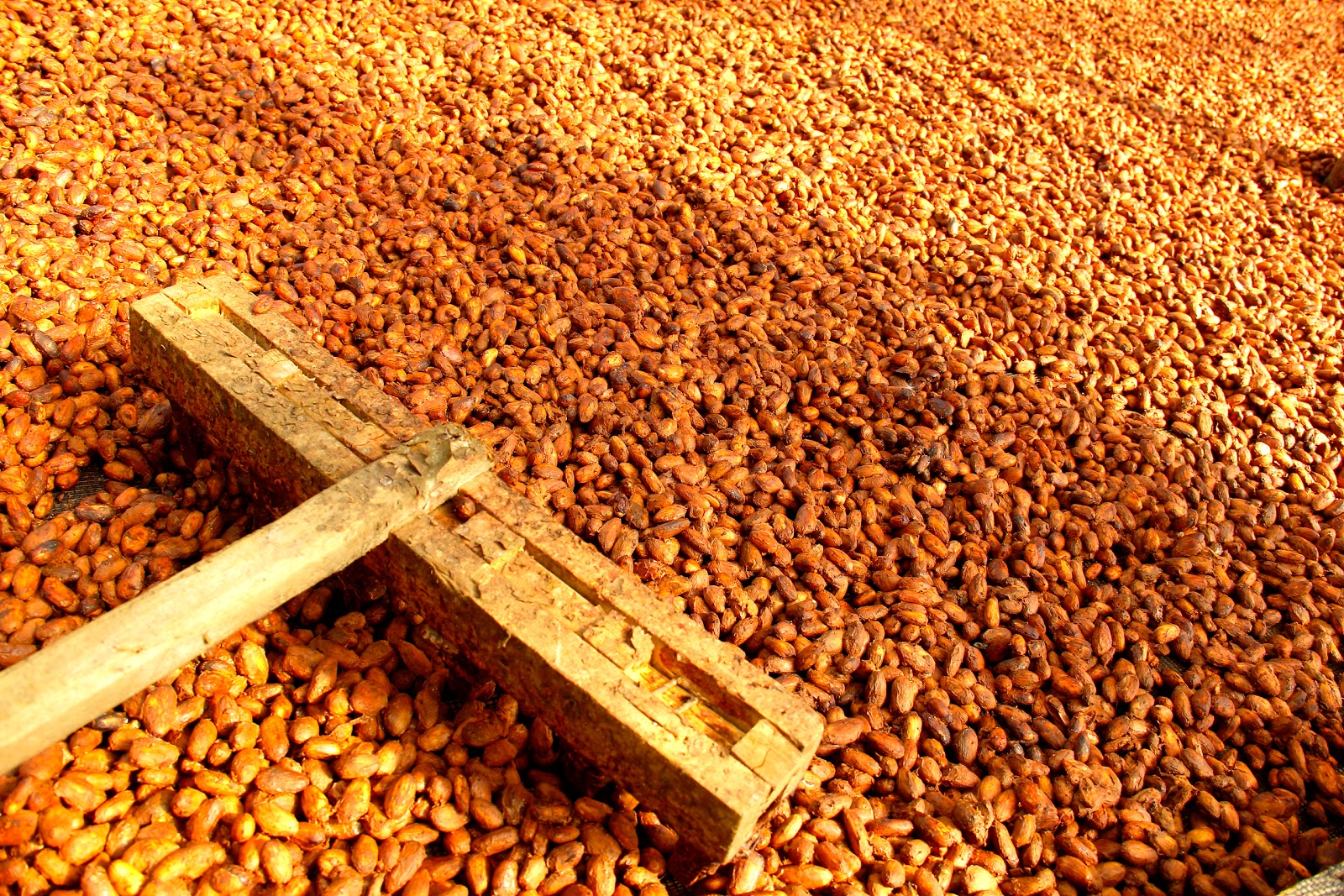
The beans are dried in specially-constructed tent-like structures.  The beans are turned twice a day for consistent drying. When the beans achieve the right color and texture, it is ready for sorting and packing.

Producing well-fermented and dried beans, well...are no easy task. Fermentation takes about 5-7 days for the full flavor of the beans to develop. Drying takes about a week or 10 days. Lucky for Mindanao, sunny days are an everyday fare. Oh! I hope Ms. Climate Change won't come down hard on these farmers. Well, at any rate....


For beans that have not yet reached its optimum dryness or have achieved the minimum moisture content required by Mars, then it is returned to the drying area. Though the structures depended mainly on the sun for heat, it is well ventilated to control humidity.

The last step in the Center is the sorting stage. The beans are packed in jute sacks. Jute, they say, allow air to pass inside which helps in keeping the seeds dry. Plastic sacks are not allowed since residual moisture are trapped inside causing molds to grow on the beans.

The Center is open for visitors willing to learn how cacao beans are processed. The Center advocates support for Cacao growers in the region, that's why the Center is open to educate people.  Locating it inside the Malagos Garden Resort is also a plus since visitors can enjoy the green and fresh environment of Davao.  The farm is big enough to house the facility, but you can still go around by foot. No need for big trucks like these to go around! well, it’s just me!

My visit at the Center definitely enriches my appreciation for our local products. Now, next time you bite into a Mars chocolate, think of it as helping also our brothers in Davao. Let's support Davao's bid to become known as the producers of a special kind "Davao" dark chocolate through their specially fermented and dried beans....go Davao Cacao! 


Related Posts Plugin for WordPress, Blogger...